Factory-Trained · Genuine OEM Parts
Wolf Repair in Chicago
Professional-grade ranges, ovens, and cooktops for serious cooks. Our technicians are factory-trained specifically on Wolf equipment, using only genuine OEM parts backed by a warranty.
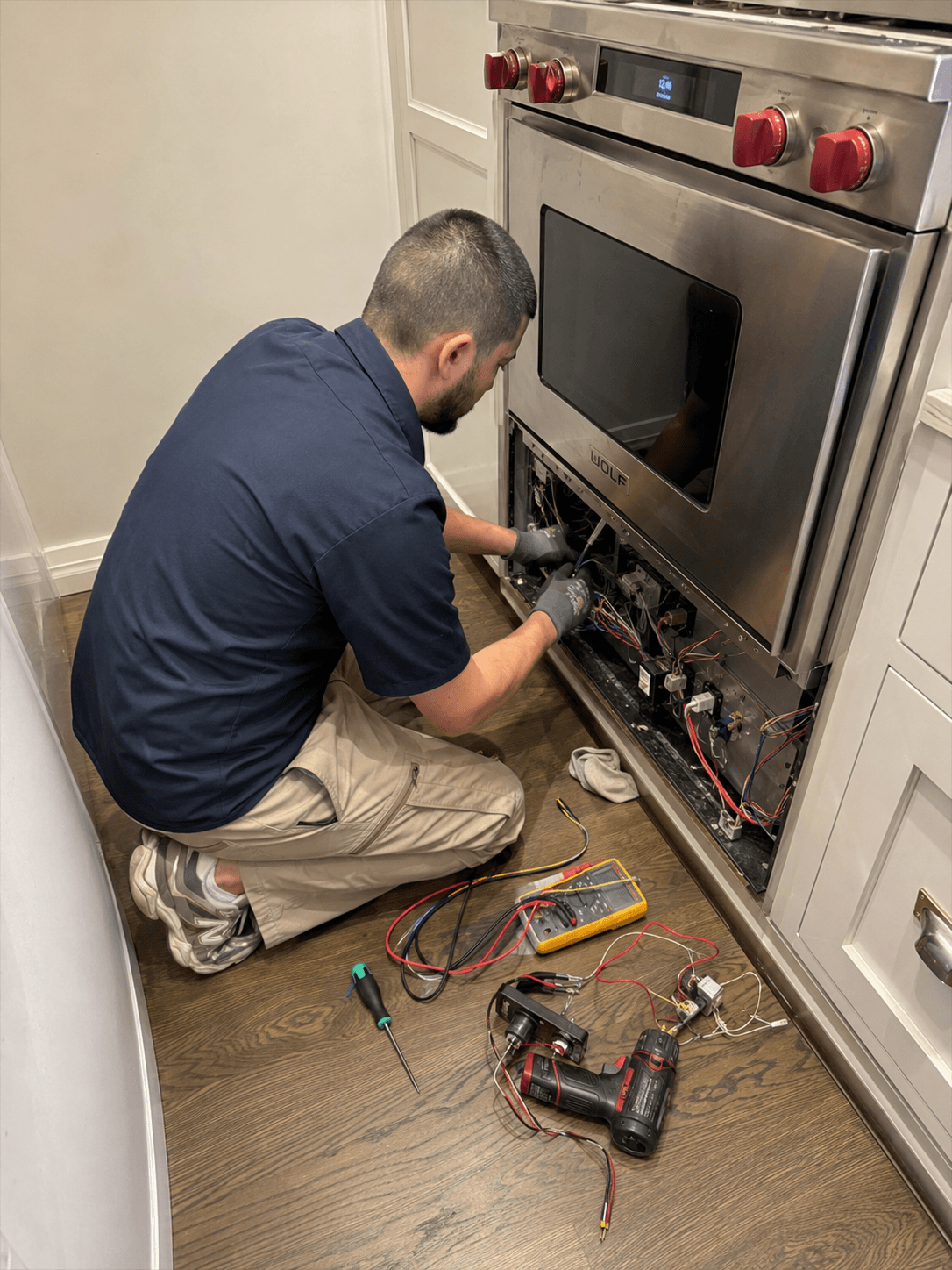
About Wolf Appliances
Wolf ranges and ovens are serviced in Chicago by technicians who understand the brand's professional-grade engineering — dual-stacked sealed burners, dual convection systems, and dual-fuel architecture that go well beyond standard residential cooking equipment. Wolf's dual-stacked burners deliver up to 20,000 BTU on the high setting, comparable to commercial kitchen equipment, while the inner ring handles precise low-heat simmering. Certified Wolf repair in Chicago means diagnosing which system is actually at fault before ordering parts — not treating a Wolf range like a standard oven.
Why Chicago Homeowners Choose Us for Wolf
Wolf owners in Chicago typically pair their range with a matching Sub-Zero refrigeration suite as part of a serious kitchen investment — Wolf equipment is engineered to perform at a commercial-adjacent level for decades. Our technicians are familiar with Wolf's dual-stacked burner assemblies, dual convection fans, and dual-fuel gas-and-electric systems, so repairs address the actual failed component rather than guessing.
Wolf Services We Provide
Gas, electric, and dual-fuel range diagnostics, igniter failures, and temperature calibration.
Gas, electric, and induction cooktop repair, including burner and control board issues.
Single and double wall oven repair, heating element failure, and control board diagnostics.
Single and double oven repair, temperature calibration, and heating element diagnostics for built-in ovens.
Common Wolf Problems We Repair in Chicago
Wolf Models We Service in Chicago
Dual-fuel and all-gas configurations in 30", 36", 48", and 60" widths
Single and 30" double wall oven configurations with dual convection
Gas and induction cooktops, plus the Wolf Convection Steam Oven (CSO)
Earlier-generation gas, dual-fuel, and wall oven configurations still in service
How We Diagnose Wolf Cooling Issues
The sequence we follow on a typical service call, in order of likelihood.
We check burner caps and ports for blockage, test the spark electrodes and igniter wiring, and verify spark module output. Wolf's dual-stacked burner design has precise gas port placement, so even partial blockage from food debris can cause ignition failure — many cases resolve with a thorough cleaning before any parts are needed.
We verify oven temperature accuracy with a calibrated thermometer. Wolf ovens can drift over years of use, and a miscalibrated temperature sensor produces cooking problems that look like range failures when the range itself is working correctly.
Wolf's dual convection design uses two fans and two heating elements to circulate air evenly. We check fan motor operation, blade condition, and both heating elements, since a failure in either fan or element causes uneven baking that's immediately noticeable in cooking results.
On gas and dual-fuel models, we verify proper gas pressure at the appliance and check all valves and connections. Dual-fuel ranges have two independent energy systems — a gas cooktop issue does not affect the electric oven, and vice versa — so isolating which system failed narrows the diagnosis quickly.
Wolf Maintenance Tips for Chicago Homeowners
- Clean burner caps and ports monthly to prevent grease buildup that restricts gas flow
- Remove and clean burner caps after any boilover — trapped moisture near the igniter causes continuous sparking
- Have oven temperature calibrated annually, since Wolf ovens can drift over years of heavy use
- Inspect door gaskets for tears or compression loss every 6 months
- Avoid lining the oven floor with foil — it blocks heat circulation and can damage the oven bottom
Frequently Asked Questions — Wolf Repair
Why won't my Wolf burner ignite?
The most common causes are clogged burner ports from food debris, a faulty spark electrode, a failed spark module, or moisture in the igniter area from a recent boilover. Wolf's dual-stacked burner design has precise gas port placement, so even partial blockage causes ignition failure. A thorough burner cleaning often resolves the issue without any parts replacement.
Can you fix Wolf dual-fuel ranges?
Yes. Dual-fuel ranges combine a gas cooktop with an electric convection oven — two independent systems that can each fail separately. We diagnose and repair both: burners, igniters, gas valves, and spark modules on the cooktop side; bake and broil elements, convection fans, temperature sensors, and control boards on the oven side.
Do Wolf ovens need special parts?
Some Wolf components — ignition modules, dual-stacked burner assemblies, and control boards — are specific to Wolf's design. We use components appropriate for Wolf's engineering standards and tell you upfront if a part needs to be ordered rather than being available same-day.
Does Wolf make refrigerators?
No. Wolf is part of the Sub-Zero Group and focuses exclusively on cooking appliances — ranges, ovens, cooktops, and the Convection Steam Oven. Sub-Zero handles refrigeration. Many Chicago kitchens pair Wolf cooking equipment with Sub-Zero refrigeration as a matched suite, and we service both.
Can you repair the Wolf Convection Steam Oven?
Yes. The Wolf CSO combines convection cooking with a steam injection system fed by a separate water reservoir. Common issues include scale buildup in the steam generator, water inlet valve failure, convection fan failure, and control board errors — the steam system requires descaling and service procedures distinct from a standard oven.
Is it worth repairing an older Wolf range instead of replacing it?
In most cases, yes. Wolf equipment is built for decades of heavy use, and most failures — burner, igniter, fan, or sensor issues — are inexpensive relative to full replacement. We give an honest assessment on the first visit and tell you directly if a repair genuinely doesn't make financial sense.